
The Domain of Integrity

"The Domain of Integrity" number 17 of 200 from Robert Aitken's book Miniatures of a Zen Master.

In this miniature, Robert Aitken contrasts what he calls the domain of integrity with the complications of justification. Or more accurately, a deepening experience of practice and it's opposite.

I notice this polarity in me. When practice deepens there is a spaciousness of intimacy, a connection with wind chimes greeting the morning breeze. When this quality is interrupted by the business and busyness of life, enter the "complicated place of justification". I can see this in me. Over and over I pick at this mess. Over and over I enter the domain of integrity.


Last night I finished reading "To Forget the Self - An Illustrated Guide to Zen Meditation" by John Daishin Buksbazen. This is one of the superior beginner books. A friendly no nonsense introduction to sitting, sangha practice and the workings of a zendo. Where this book really excels is with the photographs by John Daido Loori. I find the cover photograph to be quite haunting. In a good way. This book was published in 1978. I looked for a picture of the book on the web but could not find one. Maybe tomorrow I'll post one.
It Is to Laugh

"It Is to Laugh" number 16 of 200 from Robert Aitken's book Miniatures of a Zen Master.

This miniature is about laughter. One small quote. "Students who can't laugh can't dream with the sangha."

Zen humor is not an oxymoron. Or is it. Aitken Roshi says no. My experience on retreat has not been gut busting at all. "Zen humor" only garners a mere 14200 Google hits. (For a sense of scale, Google hits for "Christian humor" = 56700, for "Muslim humor" = 2670 , a whopping 522000 for "Gardening humor".)

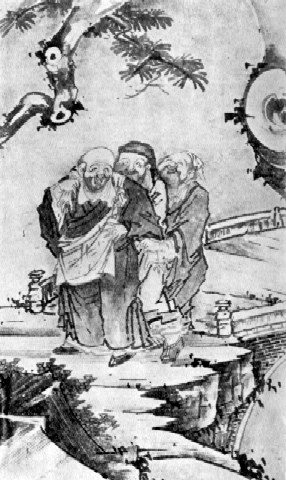
The number 1 link for "Zen Humor" is not so funny at all. Other than the old drawings of laughing monks, I couldn't muster even a chuckle. Here is one of the drawings.


Do you have any Zen humor?


I found these audio recording of Thich Nhat Hanh's current retreat. I haven't listened to them all but what I have listened to have been moving but not humorous. These seem to be being posted during the current retreat and more may become available. I've linked here to the current ones as of today that are in English. If you speak French or Vietnamese or can tolerate French to English translation then there are more audio recordings available here.

Dharma talks during Mindfulness Days in 2009 by Zen Master Thich Nhat Hanh

(Each of these is about 30mins long and less than 15meg is size.)

Spring 2009 - Thursday, March 12th, 2009
TNH Dharma Talk in English - part 1 of 2
TNH Dharma Talk in English - part 2 of 2

Spring 2009 - Thursday, March 19th, 2009
TNH Dharma Talk in English - part 1 of 2
TNH Dharma Talk in English - part 2 of 2

Spring 2009 - Thursday, March 26th, 2009
TNH Dharma Talk in English - part 1 of 2

TNH Dharma Talk in English - part 2 of 2

Spring 2009 - Thursday, April 2nd, 2009
TNH Dharma Talk in English - part 1 of 2
TNH Dharma Talk in English - part 2 of 2

Teaching yourself

"Teaching yourself" number 15 of 200 from Robert Aitken's book Miniatures of a Zen Master.

I am not your teacher. You must do the work yourself. This is kind advice and Aitken Roshi delivers it with his usual panache. Zen is a 'go with what works' method. If something works then we say it is a skillful upaya or skillful means.


Do no kill

"Do not kill" number 14 of 200 from Robert Aitken's book Miniatures of a Zen Master.

I take up the way of not killing. I take up the way of being compassionate, nurturing myself, other beings and other forms of life.


This is the first precept I took during jukai. Working through to get to this iteration of the first precept, I saw just how much killing I participate in. As Aitken Roshi points out in this miniature we do go to great lengths to reinforce our delusion that we are innocent of all the killing around us.

Taking up the way of not killing means each death is a little bit of life extinguished, my life, your life, just life. It brings on sadness and should encourage us to do better.

I live in a society that tends towards violence, I work in an industry that resists universal health care, I invest in such a way as to be ignorant of what killing I support. Even closer to home, I carry in me confusion, fear and anger.

How do we breath and keep the precepts? Plenty to work with here.


~C4Chaos pointed out this little video on his twitter feed. In it, our friend Adyashanti shows us how we can be confused by our ego-centric karmic conditioning. Really, the ego is an altered state of consciousness and "enlightenment is the *unaltered* state of consciousness." Good stuff.


"What Is Enlightenment?" Adyashanti


Ground your practice

"Ground your practice" number 12 of 200 from Robert Aitken's book Miniatures of a Zen Master.

I'm getting prepared to go on retreat (Branching Moon Sesshin) next week and I noticed this morning that my practice is a little too casual. By that I mean that my stories are leading me around. Planning, planning, planning. I really think there are three kinds of people in the world, those that tend to be forward lookers (planners, worriers) and those that tend to be backwards lookers (archivers, regretters).

The third kind are those that transcend and include both with a steady presence. An attention to the present moment that is so complete it literally hums. Practice with worry and regret, let them come and go with the breath. Watch them come and go. They have no permanence.

If I had my life to live over, I would perhaps have more actual troubles but I'd have fewer imaginary ones. ~Don Herold


For me planning is so seductive. Plenty of work to do here!

Light

"Light" number 11 of 200 from Robert Aitken's book Miniatures of a Zen Master.

This miniature points to being confirmed by the ten thousand things. There is a field of energy where the sound of the wind chime, the hum of the stove, the rustling of the sleepy dog all confirm us as alive. Alive together as this field. This is all so wonderful, cozy and Zen like.

Aitken Roshi doesn't leave it there. NO! We get pushed on, don't settle, look more.

A couple of days ago, we looked at the miniature "The Timeless" where we were admonished to "dismiss all concepts" and "dismiss all thoughts". Yet in this miniature we are asked to investigate "What are "things" that give light?" and at the end of a long list of classical, warm, cozy, Zen like "things", Aitken Roshi throws in "your thought"!

Let's see if together we can flush this out a little. In the lingo of Zen, the ten thousand things means everything. Your thought and my thought are obviously included in everything. Everything is this field of energy that we point to when we say the word life or light. Ergo, thought is this field of energy or light that Aitken Roshi asks about.

Is this investigation of thought a skillful means or 'upaya' for "dismiss all concepts" and "dismiss all thoughts" or is it just another concept/thought? Seeing what concept and thought are diminishes there ability to grab us and keep us tied down.

This is all too much talk about reality and not enough plain, vanilla, reality experienced. Time to start moving with the ten thousand things.

Killing Time

"Killing Time" 11 of 200 from Robert Aitken's book Miniatures of a Zen Master.

In this miniature we have Yamamoto Roshi reading aloud from the crime blotter of a newspaper as he admonishes his students to not be killing time. He'd say "There is no murder worse than killing time."

This reminds me of my sweeties love of pursuing the obituaries. Obits' along with the crime blotter can be used as a reminder   "there is no murder worse than killing time."

There is work to do. Work requires energy. If we don't do the work, it won't get done. Zen is not about being lazy even though it can look like that from the outside. A bunch of sitters facing the wall, hour after hour. Yamamoto points to how even here this precious opportunity shouldn't be wasted.


I am happy. Happy to be writing here. I want to be careful and clear enough that a reader who does not have this book can still get a bit of the flavor. I also want to be respectful of Robert Aitken Roshi's writings. I feel it is important I not quote the book much at all. Any confusion or errors on this blog are mine alone and the result of my misunderstand and delusion.

I want to encourage you to get the book. It is really sweet and warm. Robert is retired now and is being supported by his community and sangha. Think of a book purchase as a small way of supporting him financially and if so moved, there is a "Financial Support" link on his blog.