Love and Math by Edward Frenkel

1 of 52

This book attempts to pull back the curtain of the mystery of mathematics. I was successfully both educated and entertained. This book is about symmetries and dualities both in mathematics and ultimately in the world we live in. Who knew the Henry David Thoreau saw the connection between math and love (our world).

“The most distinct and beautiful statement of any truth must take at last the mathematical form. We might so simplify the rules of moral philosophy, as well as of arithmetic, that one formula would express them both.”

While Frenkel doubts a single formula can explain ‘everything’ he has convinced me that mathematical formulas are some of the “purest, most versatile, most economical expressions of truth know to mankind.” Mathematics is a field of discovery and not a field of human invention. Mathematics discoveries are objective truths about the world that are true no matter who or where you are in the universe and in fact it doesn’t matter if there is a ‘you' at all. 

This book was challenging to read. I don’t pretend to have grasped all the math parts. Some became clearer with Frenkel’s guidance. Many I read, letting the words wash over me and the ideas slip in were they would, not worrying about ideas too big. I also can’t pretend not to be moved by the love parts of the book. Frenkel’s biography is full of drama and his luck at meeting the right people at the right time is uncanny. His love of math and the exploration is infectious. He insists that math is democratic and being aware of this importance is a key to a rich and fulfilling live and that the way math is taught is a problem. He likes to say that if we had been taught art by just painting a fence and never shown the works of the masters, later in life you’d hate art and you’d say you were no good at it and it was not worth much. This is how we are taught math. Never exposed to the great discoveries and their relevance.  

I am grateful for being exposed by Frenkel and others to mathematics great discoveries and their relevance.

Here are some relevant links:
How our 1,000-year-old math curriculum cheats America's kids  Op-Ed in The Los Angeles Times
Why do people hate mathematics? Short Video 
All things Frenkel Berkeley 

Don't Forget To Be Awesome

Queen Zia

Well, it looks like I have a few readers. I hope I can keep you interested.

Today is auspicious. A wonderful day. Make each day as awesome as you can. Each day added to the next, together make life. If each day is awesome then life will be awesome. Easy peasy. Reviewing my 2014 Aspirations and Commitments today, looks like many are on track. Writing has been good. It helps me remember and gives me goals to shoot for. Without writing I’d forget what goals I had and would not know if I was on course or not.

It has been one year since I challenged myself to read 52 books in 52 weeks. I didn’t make it. I only read 34. For me that is something. For some of you, this is a mere pittance and I should be ashamed to call myself a reader! I can do better. So this year I will repeat. April 1 to April 1 I’ll read 52 books. I noticed early in the past year I was focusing my reading on one book at a time and doing quite well keeping up with my goal. Later in the year I started reading 3 and 4 books at a time and got stalled. I’m going to try reading just one book at a time and see how it goes.

Here is a list of the books I read last year. I can recommend all of them except where noted. I was hoping some pattern would emerge from the books I read but I can’t see it.

  • Cold Mountain by Han-shan translated by Burton Watson - Zen poetry
  • Buddhism without Beliefs by Stephen Batchlor - Zen
  • Mortality by Christopher Hitchens - Philosophy
  • The Power of Habit Charles Duhigg - Psycology 4 out of 10
  • Dog On It by Spencer Quinn - Fiction
  • Broken Music by Sting - Memoir
  • The Fault of our Stars by John Green - Fiction Tear jerker
  • The Chocolate Cake Sutra by Geri Larkin - Zen
  • War Dances by Alexie Sherman - Fiction
  • The Gifts of Imperfection by Bren Brown - Self Help
  • Cooked by Michael Pollan - Natural History
  • Art and Fear by David Bayles and Ted Orland - Art Appreciation 10 out of 10
  • On Being Certain by Robert Burton - Life changing 10 out of 10
  • As Consciousness is Harnessed to Flesh by Susan Sontag - Memoir
  • Strangers to Ourselves by Tim Wilson - Philosophy 10 out of 10
  • A Skeptics Guide to the Mind by Robert Burton - First book better
  • Stumbling on Happiness by Daniel Gilbert
  • The Dip by Seth Godin - Inspirational as usual for Seth
  • By Hand and Eye by George Walker and Jim Tolpin 5 out of 10
  • James Krenov's "A Cabinetmaker's Notebook"
  • The Five Elements of Effective Thinking by Edward Burger & Michael Starbird
  • James Krenov's "The Fine Art of Cabinetmaking"
  • Touching A Nerve, The Self As Brain by Patricia Churchland (Audible)
  • Thereby Hangs a Tail: A Chet and Bernie Mystery by Spencer Quinn -Audible
  • Making Habits, Breaking Habits by Jeremy Dean (Audible)
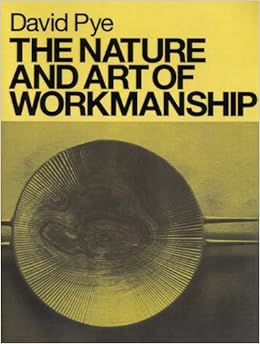
  • David Pye’s book The Nature and Art of Workmanship
  • Love 2.0 by Barbara Fredrickson (Audible Real wowo at the end)
  • The Hitchhiker’s Guide, by Douglas Adams
  • You are now less dumb by David McRaerdey
  • The Pre History of the Far Side. by Gary Lason
  • Why we make thing and why it matters by Peter Korn (10 out of 10) January
  • Transmitting the light - translated by Francis Cook February 1, 2014
  • The Reluctant Mr. Darwin by David Quammen
  • This is a Happy Marriage by Ann Pratchett Short story


This week in the shop I plan on:

  1.  finishing the welding cart that will support my welder
  2. starting on the cutting board as fine furniture for Becky
  3. get business card printed
  4. slowly start the “Shop" 

Repetition

Rejects. Discovered flaws. Design dead ends. Patterns. I save these as reminders.

More thinking on ‘working to honesty and integrity’. Working with our hands and seeing the outcomes of our labors is a powerful learning experience. Evaluating our work and comparing it to our own expectations is tricky. Some of us are of the nature to be self critical and focus on the flaws. Some of us are of the nature to be to lax and ho hum. A balance it to realize that our imagination, our creative eye is always ahead of our abilities to execute. This is a good and natural thing. This is where honesty and integrity come in. We must be honest about out intentions and their outcomes. What is it to make a spoon? If we make something with the intention to make it pretty then call it pretty. If we make a spoon, make the best spoon you can.

Repetition. Malcom Gladwell suggested that it takes 10,000 hours of practice to master a skill. This maybe true or not but it is clear that repetition and focused practice lead to skill and mastery. I started a project about 2 years ago to carve and make 400 spoons. This is a modest goal of which I yesterday finished my 200th spoon. Others have carved more and yet others have carved with more skill (prettier, more ornate, more traditional) but that is them and I am me. My skill has dramatically improved. My skill has not caught up with my creative eye and that keeps me going.

I don’t know anything about art. I must be honest about my making. I am a amateur in the best sense. I am too focused on my own making and creative eye that the distraction of “Art” doesn’t enter my world. This is all a way to get clearer. I don’t know what I think till I write it down.

This week in the shop I plan on finishing the stool tops for Paul, I have a job creating a butcher block cutting board in a special application for our landscaper, I’ll be making a tall narrow bookcase for cookbooks for Mary and I’ll be welding up a cart for my welder.

New Website

Welcome to my new website. Kestrel Creek is a phoenix, rising from the dead and trying to show new signs of life. I’ll try to not be so self-referencial or meta and try to be more sharing on my craft/making. Sometimes I just can’t help it though.

Today in the shop I’ll be moving wood in preparation for setting up my welding shop. I’ll be finish sanding the seats I’m making for Paul Wisdom. He makes wonderful stools, table and prayer wheels. Check them out at  http://www.dharmaworks.org/

Why we make things and why it matters

Finished Peter Korn’s book “Why we make things and why it matters” tonight. It was a wonderful read which I can fully and hardily recommend to anyone interested in living a ‘good’ life and making things. He eloquently weaves a narrative that has making things as the warp of a canvas with common daily activities threaded throughout to produce what a feeling of goodness. He describes three types of makers. First person, the original maker. Second person, a person experiencing the maker’s craft. Third person, the writer, critic, magazine - anybody viewing a facsimile of the object. Each has a place in the work. He describes the work of a maker as the shaping of a culture, little by little. A maker either reinforces or pushes the boundaries of what is considered normal in a culture. If the maker is a little out there, then the second and third person in this chain can reinforce or not, the makers notion. This is how design evolves.

This book is also an autobiography. Peter thought early on, that being a master craftsman meant that you’d be enlightened. And so went his search for meaning. But Peter so found out and shared that some master craftsmen are a-holes. Really what he was searching for was a good life. Something we all are after. We create our little part of the world each day. Each choice we makes adds up to our life. We are both a maker of things and a maker of our life.

Great writing and a great narrative. this I’ll defiantly reread.

The Nature and Art of Workmanship


My illness is preventing me from being in the shop being a maker. I love making things. I do a mix of my own stuff and copying what I see around me. Even when copying others designs and ideas, I impart a little of my own sensibility, sometimes to a positive affect sometimes not. While I can't get in the shop to make, I can read and write about the maker ethos.

Reading David Pye’s book The Nature and Art of Workmanship. I noticed that he was not comparing Art and Craft (he calls craftsmanship - workmanship). He looks at workings of workmanship. He uses a few terms to define the art of workmanship.

Free workmanship - outcome is an approximation if intent Regulated workmanship - outcome looks like intended repeatably

Workmanship of risk - outcome determined by worker Workmanship of certainty - outcome determined by machine/designer

I find these helpful in thinking about what I do. I tend to favor in my work a Free Workmanship of risk. He is careful not to disparage Regulated work or in some instances Workmanship of certainty. Each type of workmanship has its place. Like a scientist, he provides examples for his assertions unlike John Ruskin and William Morris, two influential figures in transition to modern workmanship. These writers railed against regulated workmanship of certainty. But according to Pye, they invoked Christianity as reason not to do regulated work. All there pointing to the harm that regulated workmanship of certainty caused was not backed up in reality. Pye points out gaps in their ideas.

One more chapter to go The aesthetic importance of workmanship, and its future.