
No Zazen for Children

"No Zazen for Children" number 86 of 200 from Robert Aitken's book Miniatures of a Zen Master.

I don't know. I have no children. I am supremely unqualified to say. Other than, once long ago, I was a child.

I have an idea that I would have benefited from zazen as a child. It is just an idea but maybe I wouldn't have benefited. I see my Zen practice as primarily made up of zazen and precept study/practice. As a child I was indoctrinated into the Christian cosmology by traditional Sunday school and traditional prayer. Till I was six or seven, all this was just absorbed, then I rebelled. I see a corollary here. Likely I would have taken the same path if it had been indoctrinated into a Zen practice instead of Christian practice.

I know someone who lives with two Zen Masters who are in the form of children. I'm sure that he would not agree with Aitken Roshi.

Aitken Roshi suggests that maybe one should wait till they are thirty-five before "beginning Zen practice". Yamada Koun Zenshin (1907—1989) was Aitken's teacher and was married to pediatrician Dr. Kazue Yamada. Kazue started all this by saying to Aitken "Don't let them even try. Send them outside to play."

Do we think Aitken Roshi and Dr. Yamada are suggesting no religious practice of any type till thirty-five and just play? Does this imply that one could be too old to practice Zen?

Dogen's Fukanzazengi (The Way of Zazen Recommended Universally) does not qualify any age at which to start practice.

My simple understanding of the historical context of Zen practice was that children stayed with their families till adolescences before going to live in the Zen monasteries. Male children only. So children did not routinely have a Zen practice. In those days, children would have had the opportunity to see Zen practitioners in their communities and it would have been natural to be curious. I can envision the children playing at imitating the monks but it probably was a boy thing. Cultural crap being what it is.

I am fifty-two and am only still beginning to practice Zen. I hope to continue beginning. I can not see when it would too early to begin beginning.


Any error or confusion created by my commentary on
Miniatures of a Zen Master
is solely a reflection of my own delusion and ignorance.
Any merit generated by this activity is solely the result of
Aitken Roshi's clear teaching and is dedicated to
all Buddhas and Bodhisattvas throughout space and time.
The Way of Yao

From WoodenZen

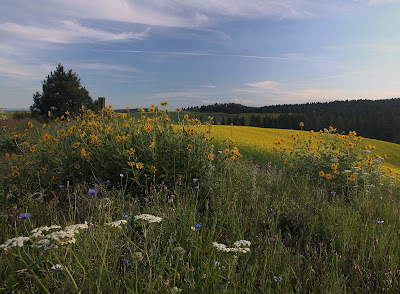
Wallen Road Rapeseed Field


"The Way of Yao" number 85 of 200 from Robert Aitken's book Miniatures of a Zen Master.

Dungshen Laingjie or as we more commonly no him as Tozan Ryokai, was the founder of what became the Soto school of Zen. He lived 806-869. We have him to thank for the Zen territorial map called the Five Ranks.

According to Aitken Roshi, Tozan encourages us to 'make the way of Yao' our own. Yao was one of the mythological emperors in the 'Three August Ones and Five Emperors' which according to legend ruled China between c. 2850 BC to 2205 BC. While Yao's and his son's, Shun, lives were complicated, they were moral and benevolent and are held up as examples even today.

Yao encouraged everyone in his kingdom to be playful and creative, to dance and sing with each other. Good advice even today!


I want to let all my friends know that Jack Duffy has started releasing the audio recordings of his sesshin Dharma talks. Here is the link to download. http://mountainlamp.org/audio/index.html I'm helping him with the this, so if you see problems or have suggestions let me know and I'll pass them on.


Any error or confusion created by my commentary on
Miniatures of a Zen Master
is solely a reflection of my own delusion and ignorance.
Any merit generated by this activity is solely the result of
Aitken Roshi's clear teaching and is dedicated to
all Buddhas and Bodhisattvas throughout space and time.

Dangerous Work

"Dangerous Work" number 84 of 200 from Robert Aitken's book Miniatures of a Zen Master.

From WoodenZen


My feelings for this book have taken on a new flavor. Maybe just flavor du jour.

These miniatures are encouragements and come in different flavors. Some are shared as fellow dinners at the table of the Way. Some are instructions from a master to whoever will listen. Some of these miniature share the foibles of discovery what this menu we call life contains.

Today's miniature is framed like two chefs conferring about their apprentices. Maybe a bit of inside baseball. I totally don't get it. "The moonlight of wisdom is indeed lunar." What is this and why would Soen Roshi refer to is a "dangerous"? And what the hell does Aitken Roshi mean by "This teaching of etymology should gave the master pause."?

I'm sure that if you are not reading along, on page 94, it is difficult to get the flavor.

Some days the soup is too salty, some days it lacks punch, some days are 'a good day'. 

Today is a good day. Let's rest in our confusion.


Any error or confusion created by my commentary on
Miniatures of a Zen Master
is solely a reflection of my own delusion and ignorance.
Any merit generated by this activity is solely the result of
Aitken Roshi's clear teaching and is dedicated to
all Buddhas and Bodhisattvas throughout space and time.

The Disadvantage of Being an Old-Timer

"The Disadvantage of Being an Old-Timer" number 83 of 200 from Robert Aitken's book Miniatures of a Zen Master.

In this miniature there is the problem of familiarity. As the routine of the dojo embeds, the surprise and mystery of dojo activities wanes. Old-timers have to be on guard for this. This is where a certain amount of forgetfulness is helpful. This is the students perspective, teachers see things differently.

I go to sesshins with the Three Treasures group from Seattle. The whole time it has been just about the same people doing the same routine in the same place (some of them in the same beds). We eat the same meals, go on the same walks, see the same sights. At the Wednesday evening meal we get the same chocolate chip cookie, the only sweet the whole week. Same, same, same.

This fall sesshin will be different. The group is experimenting with a new location. In the mountains instead of on the beach. Camping instead of sleeping in dorms. The whole thing will be shook up.

One of the big disadvantages of being an old-timer is seeing the lack of first-timers. I'm seeing a influx of people at our weekly sittings and book discussion groups. I'm encouraged by this.


Any error or confusion created by my commentary on
Miniatures of a Zen Master
is solely a reflection of my own delusion and ignorance.
Any merit generated by this activity is solely the result of
Aitken Roshi's clear teaching and is dedicated to
all Buddhas and Bodhisattvas throughout space and time.


Beliefs

"Beliefs" number 82 of 200 from Robert Aitken's book Miniatures of a Zen Master.

Beliefs, as a way of knowing things is pretty lame. One step up from ignorance. Belief is part way between ignorance and blind faith and together these 'ways of knowing' subvert reality by either ignoring it or piling on superfluous layers of imagined crap.

A more natural way of knowing is what I would call resting. Resting as in being comfortable in not knowing. Not having to understand. Not grabbing at experience and try to make it something tangible. To describe it to others in a blog post.

Have the confidence of not knowing. Knowing that you don't know. Relax into that "Don't Know Mind".

Zen Master Seung Sahn in a dialog with as student (Diana) in 1978 had this to say about belief. He refers to "true belief" and here he is talking about the absolute reality and not what we usually mean by belief.

SS: You want to believe something; this is already a mistake. So, put it all down and true belief will appear by itself (laughs). Very simple. The mind that wants something cannot believe in anything. Throw away this wanting mind. Try!

D: Try what? Can you try to believe?

SS: No! No! I didn't say try to believe. Only try. Only try means only go straight don't know; don't know means that your ideas about this world disappear. When your ideas disappear then you and this world become one. So in true belief there is no believing in something or not believing in something because it has already become one. If you and Buddha become one, how do you believe in Buddha?!

This is one mind, try mind, go straight don't-know mind and put-it-all-down mind. But many people hold their thinking: "What does he think about me? I think this about him." Holding this creates opposites when originally there was no problem.


Now for something completely related. The Faith-Mind Inscription or Poem on the Trust in the Heart.

Hsin-hsin Ming
Faith Mind Inscription

By Third Ch'an Patriarch Chien-chih Seng-ts'an

The Great Way is not difficult for those who have no preferences.

When love and hate are both absent everything becomes clear and undisguised.

Make the smallest distinction, however, and heaven and earth are set infinitely apart.

If you wish to see the truth then hold no opinions for or against anything.

To set up what you like against what you dislike is the disease of the mind.

When the deep meaning of things is not understood the mind's essential peace is disturbed to no avail.

The Way is perfect like vast space when nothing is lacking and nothing is in excess.

Indeed, it is due to our choosing to accept or reject that we do not see the true nature of things.

Live neither in the entanglements of outer things nor in inner feelings of emptiness.

Be serene in the oneness of things and such erroneous views will disappear by themselves.

When you try to stop activity to achieve passivity your very effort fills you with activity.

As long as you remain in one extreme or the other you will never know Oneness.

Those who do not live in the single Way fail in both activity and passivity, assertion and denial.

To deny the reality of things is to miss their reality; to assert the emptiness of things is to miss their reality.

The more you talk and think about it, the further astray you wander from the truth.

Stop talking and thinking, and there is nothing you will not be able to know.

To return to the root is to find the meaning, but to pursue appearances is to miss the source.

At the moment of inner enlightenment there is a going beyond appearance and emptiness.

The changes that appear to occur in the empty world we call real only because of our ignorance.

Do not search for the truth; only cease to cherish opinions.

Do not remain in the dualistic state -- avoid such pursuits carefully.

If there is even a trace of this and that, of right and wrong, the Mind-essence will be lost in confusion.

Although all dualities come from the One, do not be attached even to this One.

When the mind exists undisturbed in the Way, nothing in the world can offend, and when such a thing can no longer offend, it ceases to exist in the old way.

When no discriminating thoughts arise, the old mind ceases to exist.

When thought objects vanish, the thinking-subject vanishes, as when the mind vanishes, objects vanish.

Things are objects because of the subject (mind); the mind (subject) is such because of things (object).

Understand the relativity of these two and the basic reality: the unity of emptiness.

In this emptiness the two are indistinguishable and each contains in itself the whole world.

If you do not discriminate between coarse and fine you will not be tempted to prejudice and opinion.

To live in the Great Way is neither easy nor difficult, but those with limited views are fearful and irresolute; the faster they hurry, the slower they go, and clinging (attachment) cannot be limited; even to be attached to the idea of enlightenment is to go astray.

Just let things be in their own way and there will be neither coming nor going.

Obey the nature of things (your own nature), and you will walk freely and undisturbed.

When thought is in bondage the truth is hidden, for everything is murky and unclear, and the burdensome practice of judging brings annoyance and weariness.

What benefits can be derived from distinctions and separations?

If you wish to move in the One Way do not dislike even the world of senses and ideas.

Indeed, to accept them fully is identical with true Enlightenment.

The wise man strives to no goals but the foolish man fetters himself.

There is one Dharma, not many; distinctions arise from the clinging needs of the ignorant.

To seek Mind with the (discriminating) mind is the greatest of all mistakes.

Rest and unrest derive from illusion; with enlightenment there is no liking and disliking.

All dualities come from ignorant inference. They are like dreams or flowers in air: foolish to try to grasp them.

Gain and loss, right and wrong: such thoughts must finally be abolished at once.

If the eye never sleeps, all dreams will naturally cease.

If the mind makes no discriminations, the ten thousand things are as they are, of single essence.

To understand the mystery of this One-essence is to be released from all entanglements.

When all things are seen equally the timeless Self-essence is reached.

No comparisons or analogies are possible in this causeless, relationless state.

Consider movement stationary and the stationary in motion, both movement and rest disappear.

When such dualities cease to exist Oneness itself cannot exist.

To this ultimate finality no law or description applies.

For the unified mind in accord with the Way all self- centered striving ceases.

Doubts and irresolutions vanish and life in true faith is possible.

With a single stroke we are freed from bondage; nothing clings to us and we hold to nothing.

All is empty, clear, self-illuminating, with no exertion of the mind's power.

Here thought, feeling, knowledge, and imagination are of no value.

In this world of suchness there is neither self nor other- than-self.

To come directly into harmony with this reality just simply say when doubt arises, 'Not two.'

In this 'not two' nothing is separate, nothing is excluded.

No matter when or where, enlightenment means entering this truth.

And this truth is beyond extension or diminution in time or space; in it a single thought is ten thousand years.

Emptiness here, Emptiness there, but the infinite universe stands always before your eyes.

Infinitelfy large and infinitely small; no difference, for definitions have vanished and no boundaries are seen.

So too with Being and Non-Being.

Don't waste time with doubts and arguments that have nothing to do with this.

One thing, all things: move among and intermingle, without distinction.

To live in this realization is to be without anxiety about non-perfection.

To live in this faith is the road to non-duality, because the non-dual is one with trusting mind.

Words!

The Way is beyond language, for in it there is no yesterday, no tomorrow, no today.


Any error or confusion created by my commentary on
Miniatures of a Zen Master
is solely a reflection of my own delusion and ignorance.
Any merit generated by this activity is solely the result of
Aitken Roshi's clear teaching and is dedicated to
all Buddhas and Bodhisattvas throughout space and time.

Whitman and Dogen

"Whitman and Dogen" number 81 of 200 from Robert Aitken's book Miniatures of a Zen Master.

Walt Whitman and Dogen both pondered the question of our lives. In the long poem, Song of Myself, Whitman eventually comes to see the question as full of contradictions and yet is unsurprised and unapologetic.

...
Do I contradict myself?
Very well then I contradict myself,
(I am large, I contain multitudes.)
...  
Song of Myself - Walt Whitman
1855

Dogen speaks to this same contradiction in the Genjokoan.

...
To study the buddha way is to study the self. To study the self is to forget the self. To forget the self is to be actualized by myriad things. When actualized by myriad things, your body and mind as well as the bodies and minds of others drop away. No trace of realization remains, and this no-trace continues endlessly.
...
Actualizing the Fundamental Point (Genjokoan) - Dogen 1233


To study the self is to forget the self. As I sit, I see the transitory nature of what ever I can call self. These constellations of senses (which includes thoughts) or sense moments prove to be unsubstantial. They arise, play out and disappear and all that is left is the field on which this and that all played on.

What is the nature of that field? "I am large, I contain multitudes" begins to point in the general direction.


Any error or confusion created by my commentary on
Miniatures of a Zen Master
is solely a reflection of my own delusion and ignorance.
Any merit generated by this activity is solely the result of
Aitken Roshi's clear teaching and is dedicated to
all Buddhas and Bodhisattvas throughout space and time.


In Charge of Nature

"In Charge of Nature" number 80 of 200 from Robert Aitken's book Miniatures of a Zen Master.


Paraphrasing, 'though we forget sometimes, we know in our hearts that human beings are not in charge of nature.'

"In charge", who are we kidding? We're not even in charge of our own individual human nature.


Available rakusu rings. Lace wood, Walnut, Madrone burl


Any error or confusion created by my commentary on
Miniatures of a Zen Master
is solely a reflection of my own delusion and ignorance.
Any merit generated by this activity is solely the result of
Aitken Roshi's clear teaching and is dedicated to
all Buddhas and Bodhisattvas throughout space and time.