
Seeing and Hearing

"Seeing and Hearing" number 31 of 200 from Robert Aitken's book Miniatures of a Zen Master.


"Who is it now that hears sounds?" Bassui's big question. Will's big question. Your big question.

Sounds are funny things. We carry them around with us were ever we go. We create them on the spot. We manufacture them out of thin air. How little attention we pay to them. Just like our visions, our seeings. We see all the time, even when sleeping. Maybe you've never considered it but you are also hearing in your sleep. Hear never stops. Seeing never stops.

Cheri Huber is like to say, paraphrasing, the tenor of your life is a reflection of the focus of your attention. In other words we can not steer our hearing or our seeing or our thoughts for that matter, except by challenging and developing the focus of our attention.

Pay attention! Wake up! Be here now! These are the battle cries of those challenging their status quo.

How hears? Yes. Settle into the question. The mind wants to figure it out. It seeks an opening, a conclusion, a resolution. It sees spaciousness where it wants ideas. It screams 'What is the answer?' To attention, the question is enough.

The question for us could just as easily be "Who is it now that sees sights?" Why is this not the emphasis? I notice when sitting on the cushion, the sounds change more than the sights. Sights don't seem to have a succinct rising and ending. Of course they do but they don't appear to suddenly appear and disappear like sounds do. Sights flow together too easily. Not sounds.

Look what I've done, again - talk, talk, talk.

The printer hums,
rain washes the tin roof.
My ears ring
and together we settle.
Mu...
Mu...
Mu...
The Meaning of Jukai

"The Meaning of Jukai" number 30 of 200 from Robert Aitken's book Miniatures of a Zen Master.

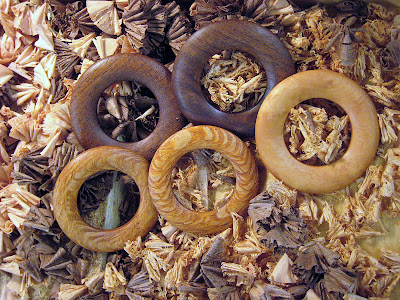
Some synergy around jukai is happening. We were asked to explain the meaning of the precepts in our book discussion group yesterday, I turned six rakusu rings in the shop yesterday and today Aitken explores jukai.

To be human, to be humane, to observe the precepts, this is what it means to practice Zen. Our rakusu are meant to remind us of our grounding in the humane, our connection with all that is human, our commitment to live the precepts. To remind us of those who have practiced in the past and will practice in the future, that the practice of Zen extends through out all of space and time.

Fun stuff. Really, sounds serious but I hold all this lightly and it helps.


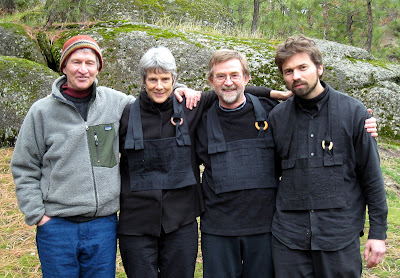
Taken after jukai at the 2007 Golden Wind Sesshin.
Jack Kenzan Duffy Roshi, Pat Hine, me, Sicco Rood


The two top ones are Walnut.
The two on the lower left are Lacewood
and the last one is Madrone Burl .


This set of rakusu ring I turned yesterday. The Walnut came from a urban tree harvest and has been air drying for about 10 years. The Lacewood comes from Australia and I can not attest to the harvest practices used. The Madrone Burl is from a off cut shared to me from Dale Larson, a Portland Oregon woodturner.


Get Serious

"Get Serious" number 29 of 200 from Robert Aitken's book Miniatures of a Zen Master.

Time to get serious. Morning has arrived and a big day is ahead.

This morning me and my homies meet to listen to a dharma talk and discuss what ever comes up. This reading slash discussion group is made up of practitioners with different levels of seriousness and even some who are not practitioners. An eclectic group. Nice that there is a couple of husband and wife pairs who come. Wish I could confidence my Mary to go. Suggest and encourage is all we can do.

"Am I being serious enough?" is a constant question for me. This is the sister question to "Am I doing it right?". Oh well, move through the day and be what happens.

Current reading list
Keep Me In Your Heart A While - Dasho Port
Mind of Clover - Robert Aitken
Essential Zen - Tanahashi & Schneider
Zen Computer - Philip Toshio Sudo
Everyday Zen - Charlotte Joko Beck

The Lesser Vehicle

"The Lesser Vehicle" number 28 of 200 from Robert Aitken's book Miniatures of a Zen Master.

Aitken Roshi looks at the heart of the greater vs. lesser vehicle dichotomy in Buddhism. He states it in a interesting way.
"Why do you seek to arouse the aspiration of your students by encouraging self-improvement when fundamentally there isn't any enduring self to begin with?"


Aitken is questioning why some teachers encourage self-improvement and by extension, why some students develop self-improvement.
This seems a bit odd for a teacher with so many psychoanalysts as
students.

This all seems a bit rhetorical though maybe not. Our practice is a bit of a balancing act. Sure, just as Old Man Linchi would say, there is nothing to do, nowhere to go. In this very body, with this very mind, in this very moment, you are Buddha.

Yet, just to say that is evidence of delusion.

We have our practice, our sangha, all the teachings, the precepts... all for encouragement, companionship and just a bit of good old fashioned self-improvement. This is all skillfully designed to help examine our life, reality as it is. In essence to wake up from a dream. To be ignorant of our personal foibles is to wallow in our delusion. To notice this short comings is to wake up a little bit. If self-improvement fosters this, upaya!

Riding the knife edge between 'always am Buddha' and practice and precepts. Not holding to one or the other. This weblog full of talk, talk, talk. My personal foible plain and clear.

How'm I Doing?

"How'm I Doing?" number 27 of 200 from Robert Aitken's book Miniatures of a Zen Master.

This has been my question too, or more accurately 'Am I doing it right?'. Looking closely, the question is not a sign of insecurity or a desire to see our rank in the sangha. Instead it is a genuine wish not to be wasting our time. The whole point in having a teacher is for a relationship to develop where the teacher can guide the student.

Let me try a Western analogy. Here in the West of the West, cows roam vast fields foraging to fill their bellies. Their minders, the cowboys, relax and let the cows peacefully wander here and there all summer long. Then when the time comes, they round them up into corrals, load them into trucks, sent them off to ... here the analogy get a bit weird.

In this analogy the cowboy knows what will happen and has done this many times before and the cow is oblivious. During the summer the cow faces many choices and some of them could lead to danger. The cows still has to walk through the corral on her own.


As you can see I'm not good at these analogies. In modern life we look for the quick remedies, the expedient means, we look for shortcuts. This is the way the West has tried to assimilate Zen.

Is it working?

Here I sit, chewing my cud of Mu.

The Heart Sutra

"The Heart Sutra" number 26 of 200 from Robert Aitken's book Miniatures of a Zen Master.


Is there a litmus test for Zen teachers? Aitken Roshi spells one out for us. He says to ask your teacher the meaning of "form is emptiness, emptiness is form" and if she starts explaining, RUN! I'll have to give this one a try.

I wonder what Dogen would do? "WWDD" Funny!


Life balance. What do that mean? I have been neglecting my wood working life in favor of my Zen life. This is going to change.

Make It Clear

"Make It Clear" number 25 of 200 from Robert Aitken's book Miniatures of a Zen Master.

Koans are not metaphors. They to be made clear through zazen.


Venus headed towards eclipse

Rare treat this morning. I watched Venus slip behind the crescent moon. I got this photo then while processing it for you, Venus got closer and closer till they touched and then both slipped behind the cloud. The cloud you see here in front of the moon got progressively thicker till it completely obscured the pair of celestial bodies. Rare indeed.

This life is a precious opportunity.